Saturday, 22 June 2013

Weaving ways


Here is some of Lin's recent beautiful work in willow.

Tall baskets with Lin's recently cut home-grown willow behind 


Spiral weaving


Trad Irish skib


Skeined shopping basket


Nature's colours


With pussy-willows


These next are the result of a commission for four large lampshades for someone's home.


 Gorgeous sculptural willow weaving, with organic flowing shapes. They are about 65cm tall.


Oval shopper


Gathering basket


Hourglass trug


Willow flowers

Regeneration


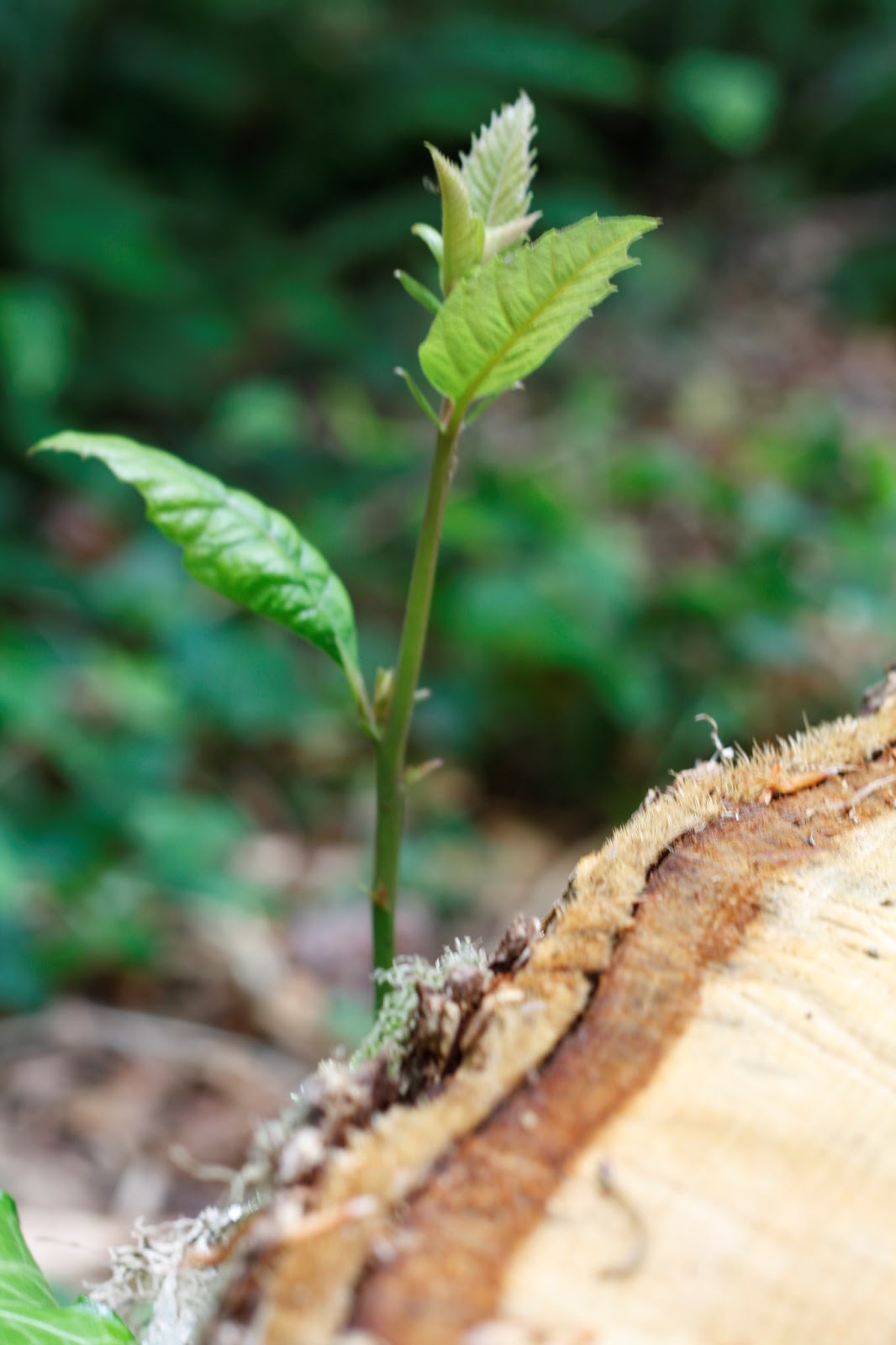
This is a snap of the stump of the Sweet chestnut tree we felled last winter for shingles. Already there is strong growth bursting from the base, searching out the light and space created by opening the forest canopy.

The coppicing of trees, if done well, is one of the few methods of husbandry that we do where the net result is largely beneficial for both ourselves and nature in general.
When a deciduous tree is felled during its dormant period (winter), it will regenerate itself the following spring, sending out many stems of new growth.

 Cutting a tree in regular cycles can easily increase its life-span by three or four times, also massively adding to the amount of biomass it produces (material we, and other animals can use). This also means the tree locks up more carbon from the atmosphere.
 Opening areas of the woodland canopy to sunlight increases growth of under-storey plants and flowers, encouraging insects, birds and mammals. Thus the biodiversity of native species is sustained over the centuries.

The woodland health and ecology is maintained, whilst providing us with fast growing material that can be used in myriad ways to produce countless practical items, shelter, fuel, food etc, not to mention areas of relative wildness essential to human emotional well-being.
Green woodworking and basketry are built on this system of coppicing and pollarding. Craftwork requires excellent quality material; clean, straight, long lengths of wood and withy that can be riven or woven. The coppiced tree uses the enormous energy stored in its root system, to push out new, multi-stemmed growth, and the individual stems must compete for light. The end result is the beautiful coppice wood we desire.

The trees we have felled could, in 10 or 20 years, be coppiced again, to make baskets, fencing, furniture, building timber and many other durable and pleasing things. We will  have been involved in a genuinely renewable and sustainable process.
Not so long ago our entire country and much of Europe ran on the products and fuels from coppice woodland. Without fossil-fuels, trees and woodland would be the most important source of energy and material we have. Unlike fossil-fuels we can harvest them in a way that does not harm our ecology.

Trees are the most wonderful things we have at our disposal, and we cant live without them. We should celebrate them more, but understand that we don't need to just preserve them, like natures museum pieces in protected enclaves; they can provide us with almost everything we need if we use them wisely, and we worked out how to do that a long time ago.


Sunday, 5 May 2013

Laying the shingles


Not done a great deal of work on the barn roof over this long, wet and cold winter; certainly not as much as we had planned, but today was a beautifully warm and sunny May day and we are starting to make real progress on one side of the roof.


Over the winter we felled a really nice straight grained, knot free sweet-chestnut that should hopefully provide us with all the good quality stuff we need to complete the roof.
Once we have ringed a few sections of the trunk into 18 inch lengths, we split them initially with a maul and steel wedges.


The quartered sections are then split with a big froe and carried through the woods to the barn.


   It is constantly surprising how easily the chestnut splits, even at this large diameter.


Chestnut has many great qualities, not least of which is the small amount of sap-wood present, meaning most of the wood is perfectly useable, and fit for long years exposure on a roof. Its natural durability, combined with its ease of riving  makes it one of the best woods available in Cornwall for green woodworking. 


  While the team got stuck into making shingles, I got on with laying down some of the stock we made earlier in the year. I'm using 38mm copper nails to fix them as steel nails will corrode and rot out quickly  with the combination of rainwater and the tannic acid in the wood.  


Only 6 inches of the 18 inch shingle is exposed, meaning each run of them is covered with the next two successive ones. It is quite possible to be able to see light shining through chinks from the inside of a properly shingled roof, and have no leaks at all.


Only finished shingles are taken up on the roof but they still occasionally need a wee trim to make
them fit snuggly to their neighbour. A shingling hammer has a little hatchet blade on its back. 


 We are putting these on while they are still green so they can be nailed on with no fear of splitting them with the nails. If they were seasoned we would be forced to pre-drill. Time consuming..


  Work doesn't get much better than this really, sun on your back, birds singing, good wood and sharp tools. Of course doing this kind of project is massively labour intensive and is made enjoyable because of the team-work involved. It would be more of  a slog on your own, but perfectly achievable given the time.


Sunday, 11 November 2012

Batten and shingles


Autumn is truly here and the leaves are falling, so its time to get the roof covered, starting with nailing down  battens and making  shingles.


The rafters and batten are cut from local larch by Jo sawmills, and they gave us some really nice stuff. 4"x 3" rafters and 2 x1" batten.


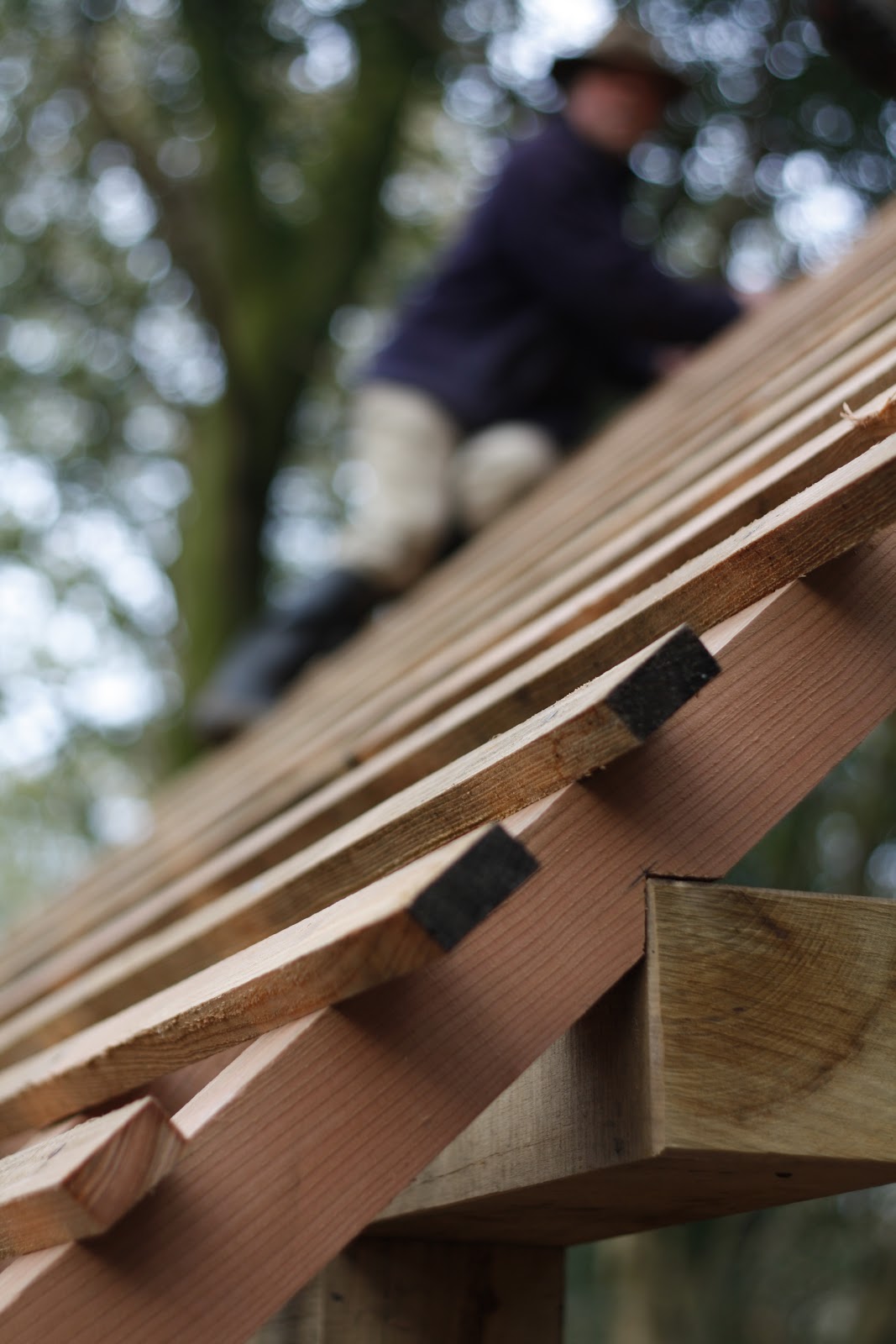
The batten is spaced at 6" centres to match the exposure of the shingles, which are 18" long, meaning the top 12" of each shingle is covered by the next layer. We nailed the batten down with galvanised nails to prevent corrosion. The durability of the larch means that it will easily last as long as the shingles, which can stay good for 70 years and more.


You make  footholds as you go. The ends get trimmed evenly once all is nailed down.


Larch has a lovely salmon colour, and is commonly used as planking for wooden boats, giving an idea of how durable it can be. There is a massive amount being felled country wide because of the phytophera contagion that is attacking it. Its nice to be able to source it but I worry whether we will see much locally in the future.


While the batten was being laid some of us started splitting out the shingles. Sweet chestnut is our choice of wood for the job, being easily splittable and very durable.


We cross-cut the bolts to the required length, then split them down the middle using a froe and mallet. Sweet chestnut is a joy to use in this way and splits incredibly easily. The most important thing is that the tree used is very straight-grained and knot free, otherwise the cleaving becomes difficult and the wastage gets unreasonable


.


You get a nice satisfying crunch as the fibres of the wood cleave apart, revealing the long story of the tree as it grew quietly in the woodland.


Then its time to trim off excess with a good sharp axe.


The drawknife then finishes it off with a nice smooth taper.


We will be needing over 2000 shingles so a long way to go, but there is no sense of hurry about this and meeting up regularly with a team of keen green woodworkers will be a great way to spend some  coming winter sundays.


Tuesday, 23 October 2012

Cruck barn in crenver grove


 Raised and raftered
 

 At long last I am finally getting round to putting up some stuff about the timber framing project I've been running in my local woodland this summer/autumn.
Over two weeks, 12 people joined me in Crenver grove, to saw, slice, chisel and bore through a pile of lovely, fresh Sweet Chestnut timbers we had felled and milled earlier in the year. These kinds of projects dont really come round very often, and the opportunity to build a traditional cruck frame on site, in a beautiful woodland, with a great bunch of folk was most enjoyable

 .
Pat cutting a housing 


There is something intrinsically satisfying about creating a building from the very trees that surround you,  a building capable of lasting hundreds of years, made from materials that quietly grow and will continue to grow. There is very little in terms of external input, really just the mobile sawmill and some tractor time shifting the trees, so it is an incredibly low impact building. Other than the odd judicious bit of chainsawing, the work was really about a few boxes and bags of good quality hand tools, and the desire and enthusiasm of the people involved.


Oooh lovely tools


 We were really lucky to have some great weather for both courses, so much of the time we were working with sunshine and bird song. I dont want to get too romantic about this but with the mix of weather, lovely people, woodsmoke, plenty of tea, wonderful materials and the sounds of hand tools being worked on green wood, the whole thing really did feel pretty special.


Plenty of tea

Most of the work we did would have been very familiar to a carpenter of medieval times, with the use of plumb bob scribing being used throughout. This allows for very accurate jointing of timbers, despite the wood being rough sawn and out of square.


Plumb-bobbing


We also used the adze alot to clean up the inside radius on the crucks and wind braces, which seemed pretty popular. It is suprising how quickly you can get good at this. One of my favorite tools.

Adam the adze


Ollie in action

All the jointing is done by carefully laying out the timbers flat and uncut, one atop the other in their relevant positions, then scribing, cutting and assembling, all in two dimensions.

Scribed and ready to cut

 
Crosscutting a shoulder
 

Assembled frame


 Timbers are marked using a tool called a timber scribe. Pretty important when you might have hundreds of unique elements in one building...
Most of the jointing is done with large mortice and tenons, with a wooden pin or peg holding it tightly together.


Carpenters marks with timber scribe and temporary steel pin


Once all the referencing is done on that particular layup, it can be dismantled and the timbers stacked away. Nothing is erected in three dimensions until raising day.


Heavy mortice chisel and a well cut tenon

I think much of the appeal of these green wood crafts lies not only in the aesthetic beauty of the objects being made (and the tools used), but also in a kind of honesty in the process. Its physical and no thrills kind of process, but the combination of care, skill and knowledge of material, and tradition passed down the centuries, results in something maybe difficult to define, but is immediately appealing to many people.


Cleaning out a mortice


 I felt by the end of each five day course we had managed to get to a pretty good level of understanding the fundamentals of trad timber framing. Actually these courses are always a bit of an experiment, because a balance must be struck between learning and simply getting stuff done, so I was really pleased that we managed so much. This has loads to do with the enthusiasm and drive of the participants and I was really fortunate in that respect. A big thankyou to all who sawed and chiselled and adzed..

Dylan chopping out and Jess on the boring machine
 

All the pictures on this post were taken by Rach weaver one of our course goers, so a massive thankyou to her for letting me use her brilliant images.


Tea break
 
Next up I will post some images and thoughts on the raising and raftering plus starting the shingle making...


Trusty shave horse for peg and shingle making

Monday, 19 March 2012

This summer I am planning to build a green oak / sweet chestnut barn in Crenver grove woods for the Sustainable Trust, a local charity involved in ecological restoration and enviromental education. The idea is to make a decent size building using trees from the woods, which can then be used to run future courses and educational workshops. As part of the process we are going to be offering a series of courses on traditional timber framing and ancient woodworking over the summer/autumn. This will be an opportunity to learn in-depth the techniques and skills needed to construct post and beam timber buildings using hand tools. I have been teaching this for nearly ten years now and am intending to make this course a special one, with loads of interesting tools and methods included, and a grand raising day at the end..


The courses will probably be 5 day duration over 3 weeks in the summer, with probably a week of voluntary work for shingling the roof. There are no finalsed dates yet, but if you are interested in attending a course you should contact Pip Richards who heads the trust-
sustrust@aol.com
01209 831718
07789600941

spring in the air

It has been quite some time since I have posted anything but like the trees, the woodland workshop has been dormant for the winter and I have been busy with my more 'conventional' carpentry work. I have really enjoyed working on a barn conversion for a friend, making a kitchen, doors, laying floors etc but with the warming weather I am very much looking forward to getting out in the fresh open air of the woods and hefting an axe and a drawknife again..
Lin and I are planning and preparing for the next round of summer courses. Lin has been doing an amazing job designing and building our new website, which will be going live hopefully in the next week... I meanwhile will be busy sourcing wood for some of the coming courses and also playing with some new ideas for courses, as well as building more doors, stairs etc etc...
We will be displaying and selling at various shows and fairs from easter onwards. Here is a brief list.

Trerife Easter fair             8th 9th April 
Trelissick woodland day  14th April
Royal Cornwall show       7th 8th 9th June

Do come and check us out if you are there..